CF-104 Starfighter
There is a significant historical connection between Albertans and the Starfighter. In 1960, RCAF Station, Cold Lake, Alberta, was chosen as the training base for the CF-104s and for 23 years the unique look and sound of the aircraft became familiar to many Albertans. Former pilots and technicians have made their home in Calgary and some have developed a significant emotional bond to this unique aircraft that they have either flown or worked on during their career in the RCAF.
Starfighter history in the RCAF
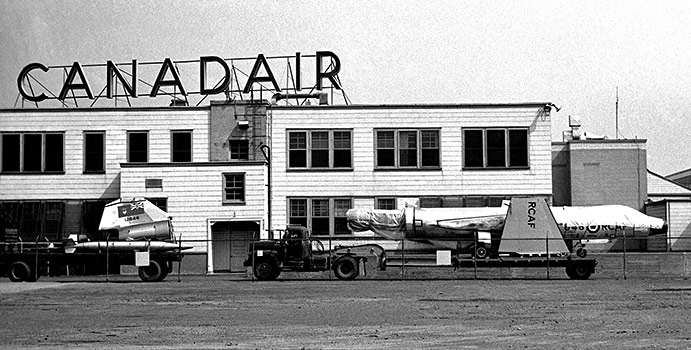
A total of 200 single-seat aircraft (12701-12900) were built by Canadair (Bombardier) in Montreal. Another 38 dual-seat aircraft (12638-12668) were built by Lockheed Aircraft in Palmdale, California. There were 113 Canadian aircraft lost during the 24 year era of the Starfighter. 37 pilots lost their lives while flying the CF-104, only four fatal crashes were due to aircraft system failures.The principal cause of crashes was due to bird strikes or other factors resulting in engine failure. Other crashes were from the nature of Canada’s NATO role which necessitated flying at high speeds at extreme low levels. Combined with the poor visibility of European skies this resulted in many aircraft being involved in controlled flight into terrain accidents.
The F-104 Starfighter was designed conceived and built by the legendary aircraft designer Clarence "Kelly" Johnson, chief engineer at the Lockheed Aircraft Corporation’s "Skunk Works" in Burbank, California. It is a high performance single-engine jet interceptor that was designed to counter the threat of Soviet nuclear-equipped Bombers. Korean War pilots had asked for a new fighter to replace the F-86 Sabres, Lockheed proposed the F-104 as a small high-speed fighter interceptor.
The Starfighter was the first fighter capable of sustained flight at speeds in excess of Mach 2. It simultaneously held both altitude and world speed records. In Canada, the Starfighter holds the Canadian altitude record. In 1967, as a centennial project, Wing Commander R.A. White flew aircraft 12700 (actually a lighter F-104C) to a Canadian record height of 100,110 feet on December 14, 1967.
Starfighter features
The aircraft has several unique design features such as a small-thin wing with sharp leading edges that were canted down 10 degrees to improve stability. The General Electric J-79 turbojet engine had the highest thrust to weight ratio of any contemporary engine and its small cross-section provided the ideal engine for the aircraft.The avionics included the latest in inertial navigation and radar. First flown in 1954, only one year after receiving a contract from the USAF, the aircraft had limited acceptance by the US military as they had moved away from the fear of manned bombers to that of intercontinental ballistic missile threats and decided the F-104 was not the aircraft they wanted for their air superiority role. As a result, the US Forces reduced their initial order from 722 and only 155 saw US service.
However in 1959, Canada had cancelled the CF-105 Arrow program and was looking for a replacement for their aging F-86 Sabres and the Starfighter was determined to be the best choice. The CF-104 was an upgraded version of the earlier F-104A with a higher thrust J-79 manufactured under license by Orenda Aircraft Canada. An order for 200 CF-104s (at a price of $1.90 million each) was placed with Canadair Aircraft, Montreal, Quebec who would build them under license from Lockheed. An additional 38 two-seater CF-104Ds were ordered directly from Lockheed in California.
Following Canada’s lead, many NATO countries purchased the F-104G which was a heavier model that had won the NATO competition for a fighter–bomber and the aircraft eventually served with the air forces of fifteen nations. Canada retired the CF-104s from service in 1987. A total of 2,578 Starfighters were built and the last operational users were the Italian Air Force who retired them in 2004 – 50 years since their first flight, truly a remarkable career for the fighter.
The Starfighter on display at the Air Force Museum of Alberta was restored to its original look and configuration as flown at Cold Lake and Europe in the 1960s. The shiny aluminum fuselage with white wings is an iconic paint scheme for the Mach 2.0 (2,336 kph) fighter – the fastest aircraft Canada has ever flown.
This was the most advanced fighter jet engine of its day. With afterburner on, it could consume all fuel onboard in under 17 minutes. A clean CF-104 (with no external tanks) could go from a standing start takeoff to 35,000 feet and Mach 2.0 in 6 minutes.
SPECIFICATIONS & PERFORMANCE
Crew
1-2
Length
55FT (16.7 M)
Wingspan
22FT (6.7M)
Height
13FT (4.2M)
Empty Weight
6,300 KG
Operational Takeoff Weight
12,100 FT
Fuel Load
5,140 L
Powerplant
ORENDA GE J79-OEL7
Thrust
10,000 LBS
Thrust with Afterburner
15,800 LBS
ARMAMENT
M61A1 Vulcan 20 mm Cannon
Multi-barrel
5,000 rounds/min
Rockets
CRV-7
CBU 1
BL-755
Bombs
Mk82 500lb
Nuclear Weapon
MK28RE 70 kiloton (US controlled)